

One page calls you a mobility brand. Another calls you a software company. A regional distributor describes you as a manufacturer. Each statement may make sense in its original setting. Put them together without context and the brand becomes difficult to describe accurately.
Building brand knowledge means deciding what each statement describes, where it applies, and what evidence supports it. Formatting comes after those decisions.
The smallest useful unit of brand knowledge is a claim with enough context to check it.
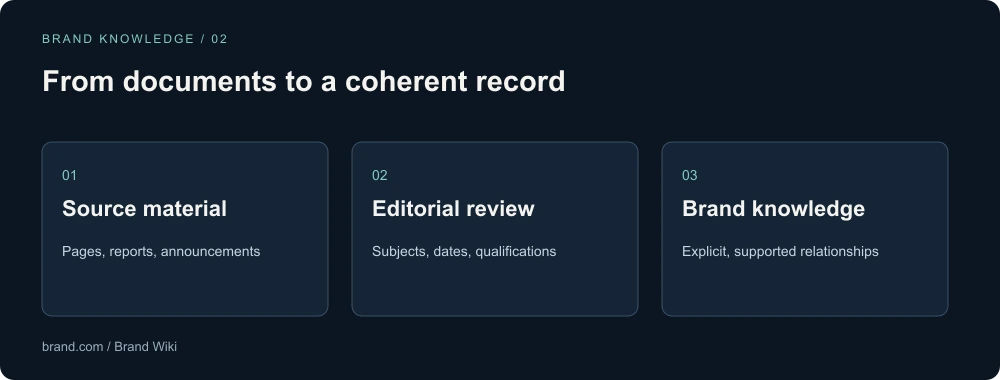
Start with the subject
Before extracting facts, identify the entity they describe. A brand, a legal company, a parent group, and a product line can share a name while referring to different things.
For the following illustrative example, Aster is a consumer brand, Aster Mobility Ltd. operates it, and Aster One is a product. These are invented names used to explain the method.
| Statement | Subject | Relationship or attribute |
|---|---|---|
| Aster is operated by Aster Mobility Ltd. | Brand | Operating company |
| Aster Mobility Ltd. is headquartered in Bristol. | Company | Headquarters |
| Aster One launched in 2024. | Product | Launch date |
If all three facts are stored under one undifferentiated name, a summary might assign the product's launch date to the company. Clear subjects make that mistake easier to prevent and detect.
Translate positioning into supported descriptions
Marketing language helps express identity. A factual record needs a description a reader can test against the products and sources.
Suppose a homepage describes Aster as “reinventing movement for a better tomorrow.” That phrase does not establish whether Aster sells bicycles, licenses software, or runs a transport service.
| Source wording | Editorial treatment |
|---|---|
| “Reinventing movement” | Preserve as positioning if relevant and attribute it |
| Product pages list electric bicycles | Describe the documented product category |
| “Available worldwide” | Verify actual markets before recording geographic coverage |
| “The leading platform” | Require a defined measure and supporting evidence |
The aim is to add a factual description that answers a different reading need. A slogan can remain a slogan.
Keep the qualifiers
A claim can be technically true and still mislead when stripped of its conditions.
“Aster offers repairs” leaves open who can obtain them and where. “Aster's UK support page lists repairs for its current bicycle range” gives the reader a defined scope.
When collecting a fact, ask:
- Which entity does it describe?
- When was it true?
- Which market, product, or business unit does it cover?
- Which source supports that wording?
- What remains uncertain?
Avoid adding detail simply because a field is available. If the source does not specify a market, record that limit rather than inventing global coverage.
Separate events from current state
Historical events and present attributes answer different questions.
An announcement that a company plans to acquire a brand is an event. Current ownership is a state that needs evidence of completion. Keeping the announcement date and transaction status prevents the timeline from silently rewriting the ownership field.
The same distinction matters for product launches, market entries, and closures. A historical launch page does not establish that the product remains on sale today.
Build a record that can be corrected
For each important assertion, retain the supporting document and enough context to understand the editorial decision. When two documents conflict, record the discrepancy before choosing a current description.
The W3C's Data on the Web Best Practices treats provenance, quality, and versioning as distinct parts of reusable data. For brand research, a practical application is to retain where a claim came from and what changed when it was revised.
This also makes individual facts easier to cite. A future editor can inspect the evidence rather than reverse-engineer a paragraph.
FAQ
Do we need a complex knowledge graph to begin?
A carefully maintained table can be a useful starting point. Name the subject, record the claim, add its source and scope, and preserve uncertainty. More advanced systems can build on that foundation.
Can an AI tool extract all the facts for us?
Extraction can help produce candidates. Review is still needed to check entity identity, source support, dates, and missing qualifiers before treating the result as a reference record.
How much detail belongs on the public page?
Enough to answer the reader's question and expose the important limits. Internal processing notes need not appear, but uncertainty that changes the meaning of a claim should remain visible.
Put the method to work
Choose one brand and trace five facts back to their sources. If a fact cannot be assigned to a clear subject or supported in context, revise it before expanding the record. That discipline is the foundation of a useful Brand Wiki profile.