

The brand's About page says 1987. A company record says 1991. A newspaper profile gives 1989. You have three sources for a founding year and no obvious answer.
The first step is to understand what each date describes. One may refer to a predecessor business, another to incorporation, and another to the launch of the name consumers recognize.
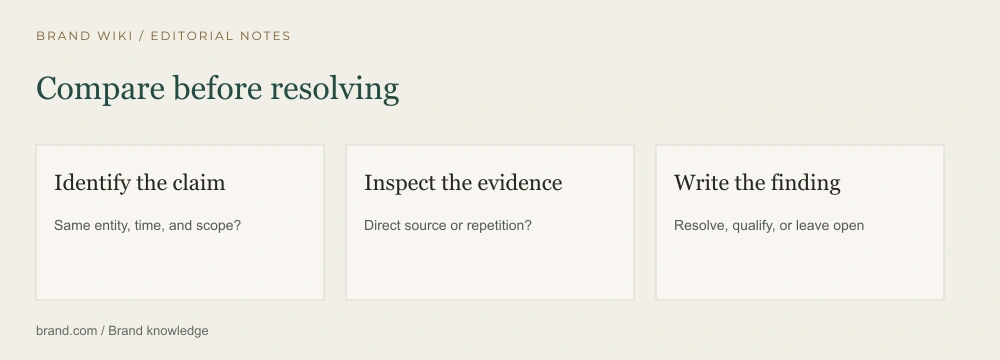
Reliable editing begins by checking whether the sources disagree about the same claim.
Resolve the meaning before resolving the mismatch.
Define the disagreement in one sentence
“The sources conflict” is too broad to investigate. “Two sources give different dates for the launch of the Aster consumer brand” gives the review a clear subject.
Aster and the dates in the examples below are fictional. They illustrate an editorial method rather than a real brand history.
| Apparent conflict | Question to check first |
|---|---|
| Different founding years | Brand launch, company incorporation, or predecessor business? |
| Different owners | Proposed transaction, completed transaction, or regional licensee? |
| Different headquarters | Brand office, company headquarters, or registered address? |
| Different product ranges | Which market and which period? |
Many disagreements become understandable once the record uses the right labels. Others remain genuine contradictions and need further evidence.
Compare the documents, not just the publishers
An official website is valuable, but a homepage and a dated transaction announcement provide different kinds of evidence. A reputable newspaper can also carry an old description or repeat an unexamined company statement.
For each document, record:
- The entity and claim it describes.
- Its publication date and the date of the underlying event.
- Its relevant market or business scope.
- Whether it provides direct evidence or cites another document.
- Any qualifications that affect the wording.
This makes the decision easier to explain. The reason for choosing one description should concern the claim it supports, rather than a blanket preference for a publisher.
Follow repeated claims back to their origin
Five pages giving the same date may all derive from one old press release. That is repetition, not five separate investigations.
Look for shared wording, attribution, and links. Where possible, inspect the originating document and determine what it actually establishes.
The W3C's Data on the Web Best Practices recommends publishing provenance information. For a brand record, a practical application is to preserve the source trail so a later editor can review how the description was formed.
Choose a treatment that matches the evidence
There are several legitimate outcomes. A review does not always end with one unqualified value.
| Finding | Suitable treatment |
|---|---|
| Sources describe different events | Label each event separately |
| A later document establishes a completed change | Update the current description and retain the earlier event as history |
| A claim is supported only as a company statement | Attribute it to the company |
| Credible accounts genuinely disagree | Describe the disagreement when material |
| Available evidence cannot support a value | Omit it or explain that it remains unconfirmed |
For example: “The company was incorporated in 1991; its official history dates the predecessor business to 1987.” This is more informative than forcing both into one founding-year field.
Do not average conflicting dates, guess an intermediate value, or silently replace an old assertion simply because another source was published more recently.
Carry the uncertainty into every representation
A paragraph may carefully explain a disputed date while the infobox displays one year without qualification. A JSON copy may remove the note entirely.
Check the summary, fact table, timeline, and any machine-readable copies together. If a representation cannot express the qualified value, it should not turn that value into apparent certainty.
This is the consistency principle behind one record in several formats. The relevant meaning must survive the change in presentation.
FAQ
Should an official source always override a news report?
Evaluate the specific claim and supporting evidence. Official materials are useful for announcements and published details, but the date, scope, and nature of the assertion still matter.
Should every disagreement appear on the public profile?
Minor discrepancies may be resolved through clearer labels. Explain unresolved differences when they materially affect the reader's understanding, and avoid presenting unsupported values as settled facts.
What if no conclusion is possible?
Keep the account narrow. Say what is supported, identify the unresolved point where useful, and avoid filling a field merely to make the profile look complete.
Leave a record another reader can inspect
The goal is a defensible account of the brand. Use Brand Wiki alongside the underlying sources, and submit a specific correction when a statement needs revision.