

A crawler appears in the server log. The request succeeds. Your brand page has been fetched.
That is useful evidence about access. It leaves several questions unanswered: what content was returned, which brand it described, whether the facts were current, and whether any of it appeared in an answer.
Treating these questions separately helps a team make specific improvements instead of celebrating a number whose meaning is unclear.
A fetched page is the beginning of an information journey. Check what the reader can actually learn from it.
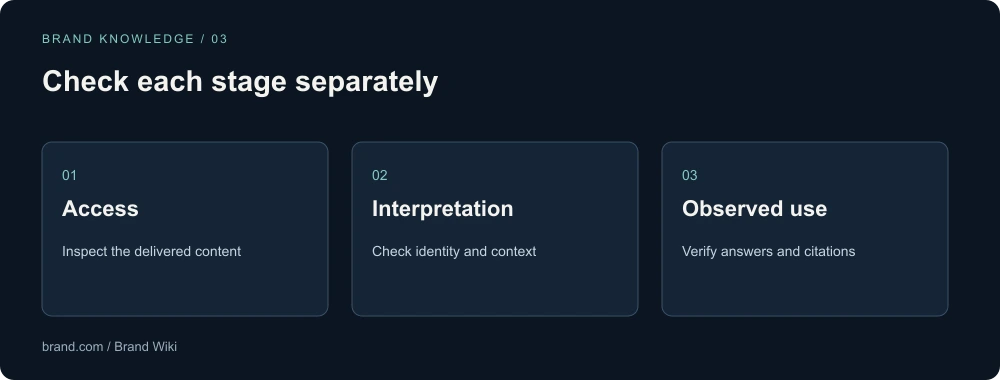
What does a crawl tell you?
A request log records an interaction with your server. Interpreting it requires context: the requested URL, response status, time, and whether the requester has been reliably identified.
A successful response can still contain a login screen, a thin application shell, or an error message delivered with a success status. Inspecting the returned content matters.
| Observation | What it supports | What it leaves open |
|---|---|---|
| A request reached the server | The endpoint received traffic | The requester's identity and purpose |
| A verified crawler fetched a profile | That crawler accessed that URL | Whether it retained or used the facts |
| The response contains the brand record | The text was available in that response | Whether the system interpreted it correctly |
| An answer links to the profile | A citation occurred in that observed answer | Whether every claim is supported or recommendations changed |
Keep these observations separate in reports. Each one answers a useful, different question.
Can the content be read without interaction?
Open the page as a reader, then inspect what the server returns. Are the brand name, description, core facts, and source links available? Do important sections require a click, a login, or a separate request?
Systems differ in how they process websites. Google's JavaScript SEO documentation describes crawling, rendering, and indexing as separate stages in its own pipeline. That is a useful reminder to test the content actually available rather than assume every reader behaves like your browser.
For a reference page, making core facts available in the initial HTML reduces dependence on interactive behavior. It still does not prove what an individual AI service will do with them.
Is the brand identity unambiguous?
Readable text can describe the wrong subject.
Imagine two unrelated businesses called Aster. One sells bicycles in the UK; the other provides accounting software in Canada. These are illustrative examples. A page titled only “Aster” leaves the reader with work to do.
A clear introduction should identify the business category and link to the official website. Relationships to an operating company or parent should be stated with sources. A logo alone cannot carry those distinctions.
The same check applies inside a corporate group. A subsidiary's product range should not quietly become the parent company's offering.
Are the facts coherent and current?
Compare the summary, fact table, timeline, and structured copies. They should agree on the subject and preserve the same qualifications.
Common problems include:
- A summary names an old owner while the timeline records a completed sale.
- A founding date belongs to the legal company in one section and the consumer brand in another.
- A regional product range is described as a worldwide offering.
- A structured copy omits the uncertainty explained on the public page.
These are editorial problems even when every request succeeds. The method in From Brand Pages to Brand Knowledge helps make those distinctions explicit.
How should a team check understanding?
Test a small set of factual questions against the record: What is the brand? Who operates it? Which market does this statement cover? What source supports the ownership claim?
First answer them by reading the page directly. Then, if testing an assistant, record its answer, links, date, and conditions. Review each claim against the sources. One correct response is an observation, not a promise about future outputs.
FAQ
Does more crawler traffic mean better brand understanding?
Traffic measures requests. It does not directly measure comprehension, factual accuracy, citations, or recommendations. Those outcomes require separate checks.
Does structured data solve ambiguous identity?
It can express identity and relationships explicitly, but incorrect or inconsistent fields remain incorrect information. Review their meaning against the visible record and supporting sources.
What should we fix first?
Confirm that the actual response contains readable core facts. Then fix unclear identity, unsupported statements, and contradictions. Measure answer accuracy separately if that is the outcome you want to assess.
Read the record, then read the log
Brand Wiki is built around accessible, sourced brand profiles. Evaluate a profile by what it lets a reader establish and verify. Use access logs as evidence about delivery, alongside that editorial review.