
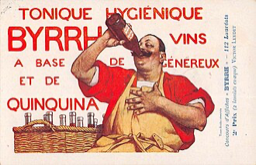
Byrrh
A French aromatised wine apéritif made from red wine, mistelle and quinine.
Last updated August 21, 2026
AI crawler reads
3requests
1companies- Anthropic3
- Profile
- 3
- Controversies
- 0
- JSON · MD
- 0
- First read
- Nov 4, 2026
- Latest read
- Nov 4, 2026
From this site's server log
Overview
Byrrh is a French aromatised wine apéritif associated with the town of Thuir in the Pyrénées-Orientales, near Perpignan. Its recipe combines red wine, mistelle and quinine, producing a fortified and botanically flavoured drink traditionally served before meals. The brand belongs to the category of wine-based apéritifs that became prominent in France during the nineteenth and early twentieth centuries. The drink was created in 1866 by Pallade and Simon Violet, brothers from Thuir who had worked as itinerant drapers. They developed the product during a period when wine production was particularly important in their region and sought to create a commercially distinctive beverage from local wine resources. Because established apéritif producers objected to direct competition, the brothers initially presented Byrrh as a health-oriented tonic rather than simply as an alcoholic apéritif. This positioning allowed the product to be sold through pharmacies and helped establish an early reputation around hygiene, strength and supposed restorative qualities. Byrrh was trademarked in 1873 and subsequently became one of France’s better-known wine-based apéritifs. Its marketing helped it achieve broad domestic recognition, particularly during the early twentieth century, when aperitif consumption and illustrated commercial advertising were expanding. The brand was also exported. Its name, however, resembled the English and German word for beer, creating a potential source of confusion in some foreign-language markets. Byrrh was sold in the United States before Prohibition, but it did not establish the same durable position there that it held in France. The brand’s historical identity is closely tied to advertising. Byrrh was promoted as a hygienic or healthful drink, a formulation that reflected both the product’s quinine content and the commercial restrictions faced by its founders. Its advertising appeared in public spaces and cultural media, and surviving Byrrh signs and references have become visual markers of historical French cafés and popular culture. The brand was also represented on the selvage of a French postage-stamp sheet issued in 1932. Byrrh advertisements and signage later appeared in films and television productions set in earlier periods, reinforcing its association with twentieth-century French life. Byrrh’s decline began during and after the Second World War. Changes in consumer preferences, together with tax advantages favoring naturally sweet wines such as Banyuls, Muscat de Frontignan and Rivesaltes, weakened the position of the traditional wine-based apéritif. Byrrh gradually fell out of fashion. In 1977, after divisions within the Violet family business, the company was acquired by Pernod Ricard. Pernod Ricard continues to produce the drink at the Thuir facility, whose site includes a section designed by Gustave Eiffel. The brand was reintroduced to the United States in 2012, indicating an effort to restore its presence in a market where it had disappeared after Prohibition. Today Byrrh remains a heritage French apéritif whose importance rests on its long history, distinctive quinine-based recipe, archival advertising and connection to the Thuir production site.
History
Byrrh originated in Thuir, France, in 1866. Its creators, brothers Pallade and Simon Violet, were itinerant drapers who turned to beverage production during a period of strong regional interest in wine. They combined dry wines and mistelles with cinchona, the source of quinine, to create an aromatised wine drink that could be sold as an apéritif. The product initially faced opposition from local producers of established apéritif brands. To avoid being treated as a direct rival, the Violet brothers presented their beverage as a health drink or tonic. This strategy was reflected in its early distribution through pharmacies and in advertising that described Byrrh as a hygienic product. The health-oriented presentation was commercially useful while also giving the drink a distinctive identity in a crowded market. Byrrh was trademarked in 1873 and grew into a major French apéritif during the late nineteenth and early twentieth centuries. Its core formulation remained based on red wine, mistelle and quinine. Marketing, public signage and commercial illustrations helped make the name familiar in France. The brand also developed an export business and was sold in the United States before Prohibition. Its name created difficulties in English- and German-speaking markets because it resembled the word for beer, which could confuse consumers or complicate attempts to explain the product category. The brand’s historical visibility extended beyond ordinary retail sales. A small Byrrh advertisement appeared on the selvage of a French postage-stamp sheet issued in 1932. Later, Byrrh signs and advertisements became recognizable details in films and television productions portraying earlier periods of French or European life. These appearances preserved the brand’s association with cafés, travel, wartime Europe and mid-century popular culture even as its commercial prominence declined. The Second World War marked the beginning of a long decline. Consumer tastes changed, and tax treatment favored naturally sweet wines including Banyuls, Muscat de Frontignan and Rivesaltes. These competing products displaced Byrrh in parts of the apéritif market, and the brand gradually became unfashionable. In 1977, the Violet family business was acquired by Pernod Ricard after divisions within the family enterprise. Production remained connected to Thuir, where the Pernod Ricard facility includes a portion designed by Gustave Eiffel. Byrrh was later reintroduced in the United States in 2012. The move restored the product to a market where it had disappeared after Prohibition, although the available reference material does not establish the scale of the relaunch. Byrrh is therefore best understood today as a continuing heritage brand within Pernod Ricard’s portfolio. Its significance comes from the combination of a distinctive quinine-flavoured wine recipe, early health-oriented marketing, deep ties to Thuir, a substantial historical advertising record and a long transition from mass-market apéritif to revival-oriented heritage product.
- 2012
United States reintroduction
[1]Byrrh is reintroduced to the United States after its earlier distribution there ended during the Prohibition period.
- 1977
Pernod Ricard acquires the family business
[1]Pernod Ricard acquires the Violet family business following internal family divisions.
- 1932
Byrrh appears on a French stamp sheet
[1]A small Byrrh advertisement is printed on the selvage of a French postage-stamp sheet.
- 1873
Byrrh is trademarked
[1]The Byrrh name is formally trademarked as the product begins building a broader commercial identity.
- 1866
Byrrh is created in Thuir
[1]Pallade and Simon Violet develop an aromatised wine drink using dry wines, mistelles and cinchona.
Products and positioning
A heritage French wine-based apéritif with a distinctive quinine flavour, historically positioned as both a refined pre-meal drink and a hygienic or tonic beverage.
Aromatised wine apéritif · 1866
Byrrh
Byrrh is a wine-based apéritif made from red wine, mistelle and quinine derived from cinchona. Its flavour profile and historical identity are linked to the bitter botanical character of quinine. The product was originally marketed as a tonic or hygienic drink and later became established as a pre-meal apéritif. Its long association with French cafés, advertising and the Thuir production site makes it a heritage offering rather than a broad product family in the available reference material.
Marketing campaigns
- 1932French postage-stamp-sheet advertisement
France
Byrrh was promoted through a small advertisement printed on the selvage of a French regular-postage stamp sheet.
Outcome. The placement remains evidence of the brand's visibility in public and commercial culture.
- 1866Hygienic drink and tonic positioning
France
The Violet brothers presented Byrrh as a health-oriented tonic rather than directly as a competing apéritif. The positioning helped the product reach pharmacies and supported advertising centered on hygiene and restorative associations.
Outcome. The approach enabled early distribution and helped establish a distinctive reputation for the brand.
Brand decisions
2012
Reintroduction to the United StatesProduct launchBackground
Byrrh had previously been sold in the United States but disappeared from that market after the Prohibition era.
Action taken
The brand was reintroduced to the United States.
Aftermath
The move restored Byrrh's availability in the American market, although the available source does not provide distribution or sales results.
1977
Acquisition by Pernod RicardM&ABackground
The Violet family business had become divided by internal family disputes.
Action taken
Pernod Ricard acquired the business and continued production at Thuir.
Aftermath
Byrrh became part of Pernod Ricard's spirits portfolio, while production remained connected to its historic French site.
Sources1 sources
Cite this profile: Cite the canonical profile. /brand-wiki/byrrh · Editorial policy · How profiles are compiled