
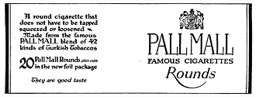
Pall Mall
Pall Mall is an international cigarette brand owned and marketed by British American Tobacco.
Last updated November 4, 2026
AI crawler reads
2requests
1companies- Anthropic2
- Profile
- 2
- Controversies
- 0
- JSON · MD
- 0
- First read
- Nov 4, 2026
- Latest read
- Nov 4, 2026
From this site's server log
Overview
Pall Mall is a cigarette brand with origins in the late nineteenth-century tobacco trade. It was introduced in 1899 and took its name from Pall Mall, the London street associated with clubs and high society. The brand initially occupied a premium position and became associated with longer-format cigarettes and innovations in cigarette design. During the twentieth century, its ownership and market role changed as the American tobacco industry consolidated. Pall Mall became particularly prominent in the United States under American Tobacco, where it was marketed as a technologically distinctive cigarette and later developed into a high-volume value-oriented brand. The brand’s history includes an important role in the evolution of cigarette formats. Pall Mall was associated with the introduction and popularization of longer cigarettes, including 85-millimetre and 100-millimetre formats, and with filter and packaging developments that were used to differentiate variants. Its brand identity has varied by country and period: in some markets it has been positioned around affordability and everyday use, while in others it has retained stronger associations with established heritage and international scale. Pall Mall became part of British American Tobacco’s brand portfolio following BAT’s acquisition of American Tobacco’s parent company, American Brands, in 2004. The transaction brought Pall Mall into BAT’s global cigarette business alongside brands such as Dunhill, Kent, Lucky Strike and Rothmans. BAT has subsequently managed Pall Mall as one of its international combustible-tobacco brands, adapting product variants, pack designs and marketing activity to local regulations and consumer preferences. The brand is sold in numerous markets, including Brazil and other countries in Latin America, Europe and Asia, although its exact product range, ownership arrangements, pack formats and market position differ by jurisdiction. Commonly encountered variants have included full-flavour, lighter or smoother-taste, menthol and longer-format products, subject to local law and availability. In some jurisdictions, descriptors and pack communications have been restricted or removed because of tobacco-control regulation. As an established cigarette brand, Pall Mall operates in a mature and heavily regulated category. Its commercial environment is shaped by excise taxes, advertising restrictions, health warnings, plain-packaging rules in some markets, smoke-free legislation and declining smoking prevalence in many developed economies. BAT continues to maintain Pall Mall within its combustible portfolio, while also placing greater corporate emphasis on reduced-risk and nicotine products elsewhere in its business. Pall Mall therefore remains principally a conventional cigarette brand rather than a standalone reduced-risk product brand.
History
Pall Mall was introduced in 1899 and named after Pall Mall, a prominent London street. The name gave the cigarette an association with British urban culture and social prestige at a time when manufactured cigarettes were becoming an increasingly important tobacco product. Early Pall Mall products were positioned toward the premium end of the market and were promoted through the visual language of established British cigarette brands. During the first half of the twentieth century, Pall Mall became connected with cigarette-format innovation. The brand was associated with longer cigarettes and with efforts to distinguish cigarettes through construction, filter technology and packaging. The longer format was commercially significant because it offered a visible point of difference from conventional king-size products and helped establish Pall Mall as a recognizable national and international brand. Pall Mall later became an important American cigarette brand under American Tobacco. Its American history included large-scale mass-market distribution and advertising, and the brand eventually moved away from its original premium identity toward a more accessible, high-volume position. Different periods saw the introduction of filter versions, longer formats and a range of taste and menthol variants. Product names and design systems varied across markets, reflecting local regulation and competitive conditions. In 1994, American Brands changed its corporate name to American Tobacco, aligning the parent company more closely with its core tobacco operations. In 2004, British American Tobacco acquired American Tobacco’s parent company. Pall Mall consequently became part of BAT’s global brand portfolio. The acquisition expanded BAT’s presence in the United States and gave the company ownership of a cigarette brand with substantial historical recognition and distribution in multiple markets. Under BAT, Pall Mall has remained a combustible cigarette brand. Its range has generally included red or full-flavour products, blue or smoother-taste products, longer formats and, where legally available, menthol products. The specific composition and naming of these variants cannot be assumed to be uniform worldwide. National tobacco regulations, taxation, consumer preferences and retail systems determine which Pall Mall products are sold in each territory. The brand’s modern history has been shaped by the tightening regulation of tobacco. Advertising and sponsorship restrictions, mandatory health warnings, smoke-free laws, limits on pack imagery and restrictions on flavour descriptors have reduced the scope for conventional cigarette marketing. In some countries, plain packaging and bans on menthol or other characterising flavours have also affected Pall Mall’s presentation and assortment. Pall Mall continues to be marketed in a number of international markets, including Brazil. Its commercial role is that of an established mainstream or value-oriented cigarette brand within BAT’s combustible portfolio. The brand’s long survival reflects the importance of distribution, price architecture, brand recognition and variant management in a mature tobacco category, while its future is constrained by falling smoking rates in many countries and increasingly stringent public-health regulation.
- 2004
Pall Mall enters British American Tobacco’s portfolio
British American Tobacco acquires American Tobacco’s parent company, thereby acquiring Pall Mall.
- 1994
American Brands adopts the American Tobacco name
American Brands changes its corporate name to American Tobacco, the corporate group associated with Pall Mall before its later acquisition by BAT.
- 1899
Pall Mall is introduced
A cigarette sold under the Pall Mall name is introduced, taking its name from the London street.
The brand becomes associated with longer cigarette formats
Pall Mall develops recognition for longer cigarette formats and related product-design innovations during the twentieth century.
Products and positioning
A mass-market international cigarette brand with heritage dating to 1899. Depending on the country, Pall Mall has been positioned as either an accessible value brand or a mainstream brand with established heritage and a broad range of formats.
Full-flavour cigarettes
Pall Mall Red
A red-pack or red-design Pall Mall variant commonly used in markets to identify a fuller-taste cigarette. Availability, blend composition, tar and nicotine yields, and pack presentation vary by jurisdiction and regulatory regime.
Mainstream cigarettes
Pall Mall Blue
A blue-design variant sold in some markets as a smoother-taste or lower-yield alternative within the Pall Mall range. The colour convention and product characteristics are not globally standardized, and the product may not be available in every country.
Menthol cigarettes
Pall Mall Menthol
Menthol versions have been sold under the Pall Mall name in markets where menthol cigarettes were permitted. Their availability has been reduced or eliminated in jurisdictions that prohibit characterising flavours, including certain major regulated markets.
Long-format cigarettes
Pall Mall 100s
A longer-format Pall Mall line associated with the brand’s historical emphasis on extended cigarette formats. Pack sizes, filter construction and variant names differ by market, and the line is subject to local product and packaging rules.
Brand decisions
2004
British American Tobacco acquires American Tobacco’s parent companyM&ABackground
Pall Mall was part of the American Tobacco business acquired by British American Tobacco.
Action taken
BAT completed the acquisition and incorporated Pall Mall into its international cigarette portfolio.
Aftermath
Pall Mall continued as a BAT combustible-tobacco brand and was distributed across multiple international markets.
Cite this profile: Cite the canonical profile. /brand-wiki/pall-mall-cigarette · Editorial policy · How profiles are compiled