
Scania AB
Swedish manufacturer and transport-solutions provider focused on heavy trucks, buses, coaches, power systems, and related services.
Last updated November 4, 2026
AI crawler reads
164requests
7AI- OpenAI107
- Perplexity20
- Amazon14
- Meta11
- Anthropic7
- +25
- Profile
- 136
- Controversies
- 18
- JSON · MD
- 0
- First read
- Oct 29, 2026
- Latest read
- Nov 19, 2026
From this site's server log
Overview
Scania AB is a Swedish commercial-vehicle and power-solutions manufacturer headquartered in Södertälje. Its principal businesses are heavy trucks, buses and coaches, industrial and marine engines, connected services, maintenance, driver and fleet support, and customer financing. The company serves long-haul freight, regional distribution, construction, mining, public transport, tourism, marine propulsion and stationary power applications. Scania traces its origins to Vagnfabriks Aktiebolaget i Södertelge, commonly known as Vabis, founded in 1891 as a railway-car producer. A second predecessor, Maskinfabriks-aktiebolaget Scania, began in Malmö in 1900 as a bicycle manufacturer and later developed vehicles and engines. The two businesses merged in 1911 to form Scania-Vabis. After early experimentation with passenger cars, buses and other products, the company increasingly concentrated on trucks and commercial vehicles. The Vabis name was dropped in 1968, when the business adopted the shorter Scania name and introduced a new truck range. The brand expanded from Sweden into international markets through distributors, overseas assembly and manufacturing. Important developments included operations in Brazil during the late 1950s and the opening of a plant near São Paulo in 1962, followed by European expansion including the Zwolle facility in the Netherlands. Acquisitions strengthened the company’s capabilities in cabs and bus bodies, while production and component operations were later established in several regions. Scania has traditionally positioned itself as a premium heavy-truck maker, emphasizing durability, fuel efficiency, driver ergonomics, uptime, service support and vehicle customization. Ownership changed several times. Scania was part of Saab-Scania from 1969 until the separation of the two businesses in 1995. It became publicly traded in 1996. A proposed Volvo takeover was blocked by European competition authorities in 2000, and a hostile approach by MAN in 2006 was subsequently withdrawn. Volkswagen gradually built control through purchases from Volvo and Investor AB, reaching full ownership in 2015. Scania became a core commercial-vehicle brand within Volkswagen’s Traton organization, alongside brands including MAN and International. Scania’s present strategy combines conventional and alternative-powertrain vehicles with electrification, renewable fuels, digital fleet management and transport-as-a-service capabilities. Its battery-electric trucks and buses are complemented by engines capable of operating with fuels such as biodiesel, biogas and other renewable or low-carbon alternatives, depending on market and application. The company also provides financial services and lifecycle support, making the brand broader than a vehicle manufacturer alone. It operates in more than 100 countries and maintains production and component facilities in Europe, Latin America and Asia. In 2025, Scania reported net sales of SEK 198.5 billion, an adjusted operating result of SEK 21.3 billion and deliveries of 94,073 vehicles; these figures are reported in the cited reference material and relate to fiscal year 2025. Scania CV Aktiebolag, commonly known as Scania, is a Swedish commercial-vehicle and power-systems company headquartered in Södertälje. Its principal activities are the development, manufacture, sale, and servicing of heavy trucks, buses, coaches, industrial engines, and marine engines. The company also supports customers through workshop services, spare parts, maintenance contracts, fleet-management tools, driver services, financing, insurance, and vehicle rental. This combination of vehicles and lifecycle services positions Scania as a transport-solutions provider rather than solely as a vehicle manufacturer. The Scania name traces its industrial history to 1911, when the company that became Scania was formed through the combination of Swedish automotive and mechanical-engineering operations. The present legal entity, Scania CV Aktiebolag, is registered in Sweden and has operated under its current name since 1994. Corporate registrations identify its activities as including heavy-motor-vehicle manufacturing, vehicle parts and bodies, repair and maintenance, and the manufacture of engines and turbines for uses outside aviation. Scania is particularly associated with heavy long-haul trucks and a modular product architecture. Modular components allow different cab, chassis, axle, engine, transmission, and body configurations to be combined for applications ranging from long-distance freight and construction to distribution, mining, municipal work, and emergency services. The R-series and S-series are prominent truck families, while Scania also supplies buses and coaches for urban, intercity, and tourism operations. Its power-engine business serves industrial and marine customers as well as transport applications. The brand’s market proposition emphasizes fuel efficiency, uptime, driver environment, durability, safety, and total operating economy. Scania has also made decarbonisation a central part of its strategy, offering alternative-fuel and electrified vehicles while continuing to develop internal-combustion powertrains capable of using lower-carbon fuels. Its sustainability agenda is connected to fleet efficiency, renewable fuels, electrification, circularity, and reductions in emissions across the transport system. Scania became part of the Volkswagen Group through TRATON, the group’s commercial-vehicle holding. It operates as a TRATON subsidiary alongside other commercial-vehicle brands and participates in selected group-scale technology and procurement activities while maintaining its own product identity and customer-facing organisation. Scania serves customers internationally through a network of sales, service, production, and financing operations. The company is active and remains one of Sweden’s best-known industrial brands.
History
Scania’s industrial history began in 1891, when Vagnfabriks Aktiebolaget i Södertelge was established in Södertälje to manufacture railway cars. In Malmö, Maskinfabriks-aktiebolaget Scania was founded in 1900 as a bicycle producer and later diversified into engines, cars and trucks. Scania’s griffin emblem derives from the coat of arms associated with the Swedish province of Scania. The two companies pursued vehicle manufacturing with uneven results. Scania’s development of dependable vehicles improved its position, while Vabis faced financial pressure. An agreement reached in 1910 led to their merger in 1911 as AB Scania-Vabis. Early production was divided between Södertälje and Malmö, and the head office moved to Södertälje in 1912. The company made cars, buses and trucks, including luxury and sporting automobiles, but the First World War redirected much of its output toward military requirements. After the war, surplus military vehicles weakened demand; Scania-Vabis entered bankruptcy in 1921 before receiving new capital associated with Stockholms Enskilda Bank and the Wallenberg family. During the interwar and wartime periods, the company developed its commercial-vehicle expertise and supplied military vehicles to Sweden, including licensed production of the Stridsvagn m/41 light tank during the Second World War. In the 1950s it expanded its dealer and service network, represented Willys Jeep and Volkswagen in Sweden, and strengthened its truck position with models such as the L71 Regent. Export activity grew rapidly, supported by effective distributors such as Beers in the Netherlands, whose training, service and maintenance practices influenced Scania’s overseas operating model. International manufacturing accelerated in the late 1950s and 1960s. Scania established a Brazilian subsidiary in 1957, opened an engine plant in São Paulo in 1959 and inaugurated a full vehicle facility near São Paulo in 1962. A factory in Zwolle, Netherlands, completed in 1964, supported access to European markets. The company also acquired cab and body specialists, including Be-Ge Karosserifabrik in 1966 and Svenska Karosseriverkstäderna in 1967. Bus production and related research were concentrated in Katrineholm. In 1968, following a logo dispute with Daimler-Benz, the company simplified its emblem and changed its name from Scania-Vabis to Scania. The 1970s and 1980s brought further production growth in Latin America and the introduction of new truck and bus ranges. Argentina became an important manufacturing and component location, while Scania also made a limited entry into the United States in the mid-1980s, initially focusing on New England. The company’s products and components were manufactured or assembled at different times in countries including Brazil, Argentina, the Netherlands, Botswana, South Korea, Tanzania, Zimbabwe and the United States. In 1969, Scania merged with Saab to create Saab-Scania. The truck and bus business became Scania AB after the group was separated in 1995, and Scania was listed on the Stockholm exchange in 1996. Volvo announced a proposed acquisition in 1999, but European competition authorities rejected the transaction because the combined company would have held an excessive share of Nordic heavy-truck markets. MAN made a hostile approach in 2006, which it later abandoned. Volkswagen gradually became Scania’s controlling shareholder. It acquired Volvo’s stake in 2000, increased its holding through the purchase of Investor AB’s interest in 2008 and obtained full control in 2015. Volkswagen’s commercial-vehicle activities were reorganized under the Traton group, which was renamed from Volkswagen Truck & Bus in 2018. Scania was delisted from Nasdaq Stockholm in 2014 as Volkswagen’s ownership consolidated. Today Scania is an international manufacturer of heavy trucks, buses, coaches and engines, supported by financing, workshop services, fleet-management tools and other lifecycle offerings. Its strategic direction increasingly combines modular engineering with connected operations, battery-electric vehicles, renewable fuels and lower-carbon power solutions. The company reported operations in more than 100 countries and nearly 53,000 employees in 2025. It also inaugurated a manufacturing hub in Rugao, China, in October 2025. Scania’s industrial lineage begins in Sweden in 1911, when the business that would develop into the Scania group was established through the consolidation of vehicle and mechanical-engineering activities. During the twentieth century, the company developed from a Swedish vehicle producer into an international manufacturer of heavy trucks, buses, and engines. Its growth was supported by export markets, a broad dealer and service network, and a product philosophy based on common modules that could be adapted to different operating conditions. The Scania name became closely linked with heavy commercial transport. Rather than producing a narrow range of standard vehicles, the company built a configurable system of cabs, chassis, axles, engines, gearboxes, and body interfaces. This approach enabled customers to specify vehicles for long-haul freight, regional distribution, construction, forestry, mining, public transport, and specialist applications. Engine and power-system activities extended the business beyond road vehicles into industrial and marine uses. Scania CV Aktiebolag is the Swedish legal company associated with the Scania operating business. Swedish company records identify registration in 1962 and state that the current corporate name has been used since 1994. The company’s registered objects include developing, manufacturing, and trading in motor vehicles, industrial and marine engines, and associated services. A United Kingdom overseas-company record shows a UK establishment opened in 1997, illustrating the company’s international corporate footprint rather than a separate British automotive brand. Scania was separately listed for part of its corporate history, but the company later became controlled by Volkswagen. Volkswagen’s commercial-vehicle activities were subsequently organised under TRATON SE, and Scania became one of TRATON’s principal operating brands. The ownership transition changed Scania’s corporate setting while preserving its distinct engineering, brand, sales, and service identity. Scania is now managed within the TRATON Group and is not an independently listed stock-market company. In the twenty-first century, Scania expanded its proposition from vehicle manufacture toward complete and sustainable transport solutions. The offering increasingly combines vehicles with financing, insurance, maintenance, parts, repair, rental, digital fleet tools, driver support, and operational analysis. Connected services help operators monitor vehicle performance, fuel use, maintenance needs, and fleet utilisation. Environmental performance has become a major strategic theme. Scania has developed vehicles and engines for alternative fuels, including renewable and gas-based solutions, while introducing battery-electric trucks and buses. The company continues to improve conventional powertrains because many heavy-duty applications require long range, high payload, rapid refuelling, or access to limited charging infrastructure. Its strategy therefore combines electrification with renewable fuels, improved logistics, driver training, and higher vehicle utilisation. Today Scania operates internationally, with production, sales, service, and financing activities serving customers across multiple regions. Its core identity remains that of a premium heavy-transport manufacturer, but its business scope includes services and systems intended to improve the economics and environmental performance of commercial fleets.
- 2025
Rugao manufacturing hub inaugurated
[1]Scania inaugurates a manufacturing hub in Rugao, China.
- 2022
Russian operations discontinued
[1]Scania stops deliveries and production in Russia and begins selling its local assets.
- 2020
Volkswagen ownership relationship reaffirmed
[6]Ownership data records Volkswagen AG in the Scania corporate relationship in January 2020.
- 2018
Traton identity introduced
[1]Volkswagen Truck & Bus is rebranded Traton, placing Scania within the group’s commercial-vehicle structure.
- 2017
Volkswagen ownership recorded
[6]External ownership records identify Volkswagen AG as an owner from November 2017; Scania is now operated within TRATON.
- 2015
Volkswagen obtains full ownership
[1]Volkswagen Group reaches full ownership of Scania AB.
- 2014
Delisting from Stockholm
[1]Scania is delisted as Volkswagen’s ownership consolidates.
- 1997
United Kingdom establishment opened
[4]Companies House records show the opening of Scania CV Aktiebolag’s UK overseas establishment in June 1997.
- 1996
Stock-market listing
[1]Scania is introduced on the Stockholm stock exchange.
- 1995
Separation from Saab
[1]The truck and bus business resumes the Scania AB name after Saab-Scania is separated.
Products and positioning
Premium commercial-vehicle brand focused on total operating economy, reliability, safety, driver experience, modular vehicle engineering and lower-emission transport solutions.
Heavy trucks
Scania heavy trucks
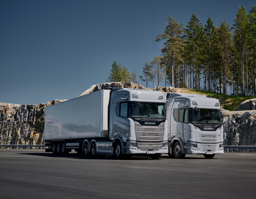
Scania’s core product family comprises heavy trucks for long-distance haulage, regional distribution, construction, mining and specialized transport. The modular platform supports multiple cab types, wheel configurations, engines, transmissions and body applications. P-, G-, R-, S- and L-series cabs are associated with different operating environments, from urban distribution to long-haul work. The range includes diesel and alternative-fuel powertrains as well as battery-electric models. Scania produces heavy trucks for long-haul freight, regional distribution, construction, mining, forestry, quarrying, and specialist operations. Configurable cabs, chassis, axles, powertrains, and body equipment allow vehicles to be specified for different payloads, routes, climates, and regulatory requirements. The range includes diesel, alternative-fuel, and battery-electric solutions, supported by connected services, maintenance, parts, and driver-oriented systems.
Buses and coaches
Scania buses and coaches
Scania supplies chassis and complete buses for city transport, intercity routes, tourism and other passenger applications. Products are configured for different bodybuilders and operating conditions, with attention to fuel economy, passenger capacity, accessibility, safety and serviceability. The portfolio includes urban buses such as Citywide and long-distance coach offerings such as Touring, alongside alternative-fuel and electric solutions in selected markets. Scania supplies chassis, complete buses, and coaches for urban, intercity, school, touring, and special transport applications. Its bus business supports multiple body configurations and powertrain choices, including solutions designed for electrification and alternative fuels. Vehicles are accompanied by service, parts, financing, and fleet-support offerings intended to maximise availability in scheduled passenger transport.
Industrial power systems
Scania industrial and marine engines
Scania develops engines and complete power solutions for industrial equipment, construction machinery, agricultural applications and stationary generation. These products extend the company’s heavy-duty engineering beyond road vehicles and can be adapted to different emissions regulations, duty cycles and fuel requirements. Scania also supports customers through parts, service, monitoring and maintenance capabilities. Scania develops engines and power systems for industrial machinery and marine applications in addition to road vehicles. These products are adapted for different duty cycles and installation requirements and are supported by service and parts capabilities. The business extends Scania’s modular powertrain expertise into equipment and vessels where reliability, fuel consumption, emissions compliance, and serviceability are important. Scania’s marine engines serve commercial and workboat applications as well as other marine propulsion and auxiliary-power needs. The business emphasizes compact installation, durability, service access and performance under demanding duty cycles. Engine offerings are supported by a global service network and can be integrated into broader vessel and fleet-maintenance programs.
Connected and financial services
Scania services and financing
Scania’s commercial offering includes workshop maintenance, parts, repair contracts, driver support, fleet management, telematics, uptime services and customer financing. These services are intended to manage the total cost of ownership over a vehicle’s lifecycle. Digital tools can provide operational data for scheduling, fuel management, safety and vehicle utilization, while finance products help customers acquire and operate commercial vehicles.
Long-haul trucks
Scania R-series
The R-series is a Scania truck family associated with long-distance and demanding transport work. It combines a range of cab configurations with Scania’s modular chassis and powertrain systems, allowing operators to balance driver comfort, payload, fuel consumption, and operating range. Depending on market and specification, the family can be configured with conventional or lower-emission powertrains and with a broad selection of axle and body arrangements.
Long-haul trucks
Scania S-series
The S-series is a premium long-haul truck line designed around a spacious, flat-floor cab and extended-distance driver use. It is offered with different engines, transmissions, axles, safety systems, and digital support functions. The product is intended for operators that value driver accommodation and productivity alongside fuel efficiency and the ability to integrate the vehicle into a managed fleet.
Transport services
Scania financial and fleet services
Scania’s broader offering includes vehicle financing, insurance, rental, maintenance, repair, spare parts, workshop tools, fleet-management systems, and connected transport services. These services are designed to support the vehicle throughout its operating life, improve uptime and utilisation, and help customers manage fuel, maintenance, driver performance, and total operating cost.
Controversies
2017
European truck price-fixing cartel
The European Commission fined Scania EUR 880 million for participating in a truck-manufacturer cartel that operated over approximately fourteen years. The case concerned coordination on pricing and the timing and pass-through of emissions-related technologies.
Brand decisions
2020
Scania enters the U.S. recreational marine marketStrategyBackground
Scania entered the U.S. recreational marine market with newly launched 13- and 16-liter engines certified for the pleasure-craft market.
Recent events
Partners inaugurate biodiesel pilot in Côte d'Ivoire[9]
Reported
Scania West Africa, TotalEnergies Marketing Côte d'Ivoire, ANADER and LA SIR inaugurated a biodiesel pilot in Abidjan. The pilot aims to reduce emissions from public transport and create jobs through locally produced biofuels.
Scania Southern Africa launches Euro 6 V8 770S truck in South Africa[10]
Scania Southern Africa launched its Euro 6 V8 770S truck in South Africa. The article says the company cited improved fuel efficiency and decreased carbon emissions among the model’s features.
Scania opens battery assembly plant[11]
Reported
Scania opened a purpose-built battery assembly plant in Södertälje, Sweden, to assemble battery cells into modules and packs.
Scania launches vehicle production in Kazakhstan[12]
Reported
Scania launched production of its transport vehicles at the QazTehna plant in Kazakhstan's Karaganda region.
Scania announced Scania Charging Access[13]
Reported
Scania announced Scania Charging Access, a public-charging service for trucks and buses with predictable costs and consolidated invoicing. The company said the service would launch in multiple European countries in October.
Scania launches new inline engine platform[14]
Reported
Scania launched its next-generation inline engine platform for power solutions, describing improved fuel efficiency, engine lifespan and CO2 emissions compared with the current generation.
Scania launches S+ fleet management system in China[15]
Scania launched its S+ fleet management system in China in July, with G7 IoT providing technical support for terminal equipment and after-sales service during the system's rollout.
Scania partners to develop a Thohoyandou workshop[16]
Scania South Africa partnered with the Limpopo Economic Development Agency and Thulamela municipality to develop the R15-million Scania Thohoyandou workshop. The workshop was slated to be built by April 30, 2021.
- Unconfirmed
Scania enters the U.S. recreational marine market[8]
Reported
Scania entered the U.S. recreational marine market with newly launched 13- and 16-liter engines certified for the pleasure-craft market.
Sources18 sources
- 1Scania ABen.wikipedia.org
- 2Scania official websitescania.com
- 3Scania CV Aktiebolag company information, SYNAupplysningar.syna.se
- 4Scania CV Aktiebolag, Companies Housefind-and-update.company-information.service.gov.uk
- 5Scania CV Aktiebolag corporate informationkrafman.se
- 6Scania CV Aktiebolag, OpenSanctions entity recordopensanctions.org
- 7Scania CV AB company profile, Bloombergbloomberg.com
- 8Scania enters the U.S. recreational marine markettradeonlytoday.com
- 9合作方在科特迪瓦启动生物柴油试点prnewswire.com
- 10斯堪尼亚南部非洲公司在南非推出 Euro 6 V8 770S 卡车engineeringnews.co.za
- 11Scania电池组装厂投入运营bigrigs.com.au
- 12Scania 在哈萨克斯坦启动车辆生产trend.az
- 13斯堪尼亚宣布推出 Scania Charging Accessprnewswire.com
- 14斯堪尼亚推出新型直列发动机平台prnewswire.com
- 15斯堪尼亚在中国推出S+车队管理系统tech.china.com
- 16Scania合作开发Thohoyandou维修中心engineeringnews.co.za
- 17Scania launches new battery-electric bus platform at Busworldprnewswire.com
- 18Scania Unveils Cutting-Edge Battery-Electric Bus Platform at Busworld - CleanTechnicacleantechnica.com
Cite this profile: Cite the canonical profile. /brandpedia/scania-ab · Editorial policy · How profiles are compiled