

A brand's website names one company in the footer, another in a privacy notice, and a group in its press releases. Which one belongs in the brand's profile?
Often, more than one belongs there. The editorial task is to explain each relationship rather than choose a name and treat every other entity as interchangeable.
A useful brand wiki describes both the subject and the connections that help a reader understand it.
Before asking whether a fact is correct, ask whose fact it is.
Start with three separate questions
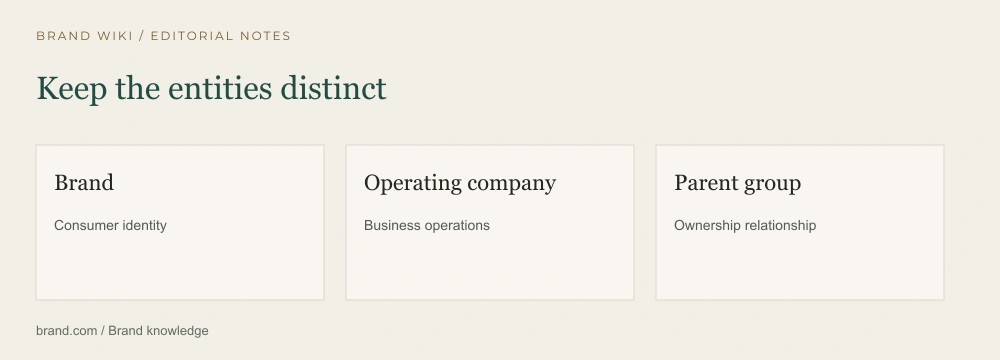
What is the brand? Who operates it? What ownership relationship can be established? Each question can lead to a different entity.
Consider Aster, an invented bicycle brand. Its store is operated by Aster Mobility Ltd., which a disclosure identifies as a subsidiary of Meridian Group. Aster One is the name of a bicycle in the range.
| Entity | What the record describes | A fact that belongs here |
|---|---|---|
| Aster | Consumer brand | Brand launch and product category |
| Aster Mobility Ltd. | Operating company | Company registration and business address |
| Meridian Group | Parent group | Group-level history and portfolio |
| Aster One | Product | Model specifications and launch date |
These names are fictional. The distinctions apply to actual research only when the relationships are supported by evidence.
The parent group's founding year does not become the brand's launch date. A product's manufacturing location does not automatically establish the company's headquarters.
Name the relationship precisely
“Associated with” can conceal several different arrangements. Replace it with a specific description when the source supports one.
| Relationship | What to establish | What to avoid assuming |
|---|---|---|
| Ownership | Which entity holds the relevant interest, and when | That a proposed acquisition has closed |
| Operation | Which company runs the described business | That an operator owns every relevant trademark |
| Licensing | What the licence covers, where, and for how long if disclosed | That the licensee owns the brand outright |
| Distribution | Which products or territory the agreement covers | That a distributor is the parent company |
A regional website may identify the seller for that market. That is useful evidence for local operation, but it may leave global ownership unresolved.
Keep the scope visible. “Distributor in the UK” tells the reader more than placing the distributor's name in an unqualified “Owner” field.
Check the source against the connection
Read corporate disclosures, official announcements, legal notices, and other relevant records for the relationship they actually establish. A shared logo or a link in a portfolio page may suggest a connection that still needs clarification.
For an acquisition, distinguish an agreement announcement from completion evidence. For a licence, distinguish permission to use a name in a category from a transfer of ownership.
Record the source and the relevant date. If no suitable document establishes the connection, narrow the wording or leave the relationship unresolved. The principles in What Makes a Brand Fact Worth Citing? apply to relationships as well as standalone attributes.
Give every date a meaning
Brand histories often inherit dates from nearby entities. An operating company can predate the consumer brand. A brand can continue through a change of operating company. A parent group can be formed long after a brand's first product appeared.
Instead of collapsing these into a single “Founded” date, distinguish company incorporation, brand launch, and earlier trading history where the evidence permits.
The same discipline applies to geography. A brand's origin, the operator's headquarters, and the parent's registered address can all be different places.
Make the connections readable
A profile does not need to overwhelm the reader with every intermediate entity. Explain the relationships relevant to identifying the brand, and link to related records where available.
Avoid shortening a documented multi-step relationship into direct ownership if that changes its meaning. If the detailed structure cannot be confirmed, say what the source establishes and where the account stops.
This approach makes brand knowledge easier to inspect: each assertion has an identifiable subject, rather than floating between similarly named organizations.
FAQ
Should the brand and operating company always have separate pages?
Separate records can be useful when their identities, histories, or activities differ substantially. A combined profile can also work if it clearly distinguishes the subjects within the page.
Does a company name in a website footer prove brand ownership?
It may identify a site operator or a contracting business. Check what the notice says and seek evidence for the specific ownership relationship before drawing that conclusion.
What if the parent relationship cannot be confirmed?
State only the supported connection. An unknown parent is preferable to an inferred owner that later spreads through summaries and data exports.
Review the relationship before the summary
Open a Brand Wiki profile and ask whether each company, brand, and product is clearly identified. Then follow the source for the connection between them. A reliable summary starts with those distinctions.