
Your homepage may explain what your brand stands for beautifully. A researcher can still leave it unsure which company owns the brand, when it launched, or whether a product is available in their market.
Those answers may exist somewhere: a newsroom announcement, a regional site, an investor document. Finding and connecting them is another job.
A brand wiki brings those facts into a coherent reference record. Making that record easy for AI to read extends the same benefit to automated research.
A useful brand wiki gives every important fact a place, a meaning, and a source.
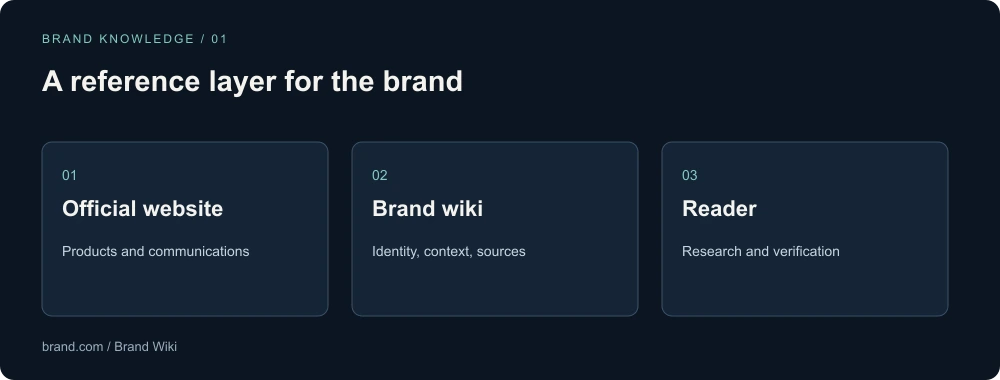
What does a wiki add to an official website?
A website serves many purposes. It launches products, supports customers, recruits employees, and sells. Its structure follows those priorities.
A wiki starts with a different question: what would someone need to know to identify and understand this brand accurately?
| Reading need | Typical website destination | What a wiki can bring together |
|---|---|---|
| Identify the brand | Homepage or About page | Name, aliases, category, official website |
| Understand ownership | Corporate pages or announcements | Brand, operating company, parent relationship |
| Follow its history | Newsroom archive | Dated milestones with supporting sources |
| Understand its offer | Product and regional pages | Product scope with market context |
| Verify an assertion | Scattered documents | A source attached to the relevant fact |
The website remains essential. The wiki helps readers navigate the factual record that surrounds it.
Why does this matter for AI readers?
An assistant researching a brand needs to connect names, relationships, and dates across the information it retrieves. Ambiguous pages make that task harder to check.
Consider an illustrative brand called Aster. Its homepage says “Built for every journey.” Its legal footer names Aster Mobility Ltd. A press release announces that Meridian Group has agreed to acquire the company.
Three documents now describe three different things: positioning, an operating entity, and a proposed transaction. A useful wiki keeps those distinctions intact. It does not turn an acquisition announcement into a completed ownership change.
This is the work of turning brand pages into brand knowledge: making the relationships explicit while preserving the evidence behind them.
What belongs in the record?
Begin with the facts readers repeatedly need:
- Identity: brand name, relevant alternative names, and official website.
- Relationships: operating company, parent company, and the nature of each connection.
- Scope: products, services, categories, and applicable markets.
- History: dated milestones with clear event descriptions.
- Evidence: sources, qualifications, and a meaningful review date.
Completeness has limits. If ownership cannot be confirmed, say so. If two reliable sources disagree about a founding date, explain what each date refers to. A blank field with an explanation is more useful than a confident guess.
Who maintains the facts?
A wiki needs an editorial process as much as a publishing format. Someone must review corrections, distinguish company statements from independently established facts, and decide when a record needs updating.
For an internal brand team, that means assigning responsibility for different fact types. For a public reference platform, it also means explaining how submissions and sources are assessed.
Being allowed to submit a correction should never imply permission to turn the record into advertising. The value comes from a record readers can inspect and challenge.
What should “AI-readable” mean here?
It should mean that the factual content is accessible, organized, and understandable without unnecessary interaction. Clear headings and source links help human readers too.
Some platforms also offer structured copies of the same record. Those copies are useful when they preserve the same facts and qualifications as the public page.
None of these choices guarantees a citation or recommendation. Google's guidance for its AI search features says that no special optimization is required for eligibility. A wiki earns its practical value through the quality and accessibility of its information.
FAQ
Can a wiki replace our official website?
Your official website remains the primary destination for products, services, support, and company communications. A wiki complements it with an organized reference record and links back to supporting material.
Should every fact come from our own website?
Choose sources according to the claim. Official materials can establish what a company announced or offers. Ownership, disputed history, and broader context may require other records and independent reporting.
Will a wiki make AI assistants recommend the brand?
A readable, sourced record can support research. Recommendation depends on the question, the system, and other evidence. Publication alone cannot establish that outcome.
Start with one brand record
Open a profile in Brand Wiki. Ask whether a new reader can identify the brand, understand its relationships, and follow the sources. Those are useful first tests of a record built for both people and AI.